
Barents Sea Capelin - Scientific Advice
Publisert den 11.12.2025 av Per Arne Fagervoll Meek
Scientific advice from IMR PINRO and JRN AFWG
On 10 December 2025, IMR and PINRO published their joint report "IMR PINRO Joint Report 2025 8 Advice on fishing opportunities for Barents Sea capelin in 2026". The assessment follows the methodology established in the latest ICES benchmark.
The key conclusion is that, when the Joint Norwegian Russian Fisheries Commission management plan is applied, there should be zero catches of Barents Sea capelin in 2026.
Why zero catch is advised
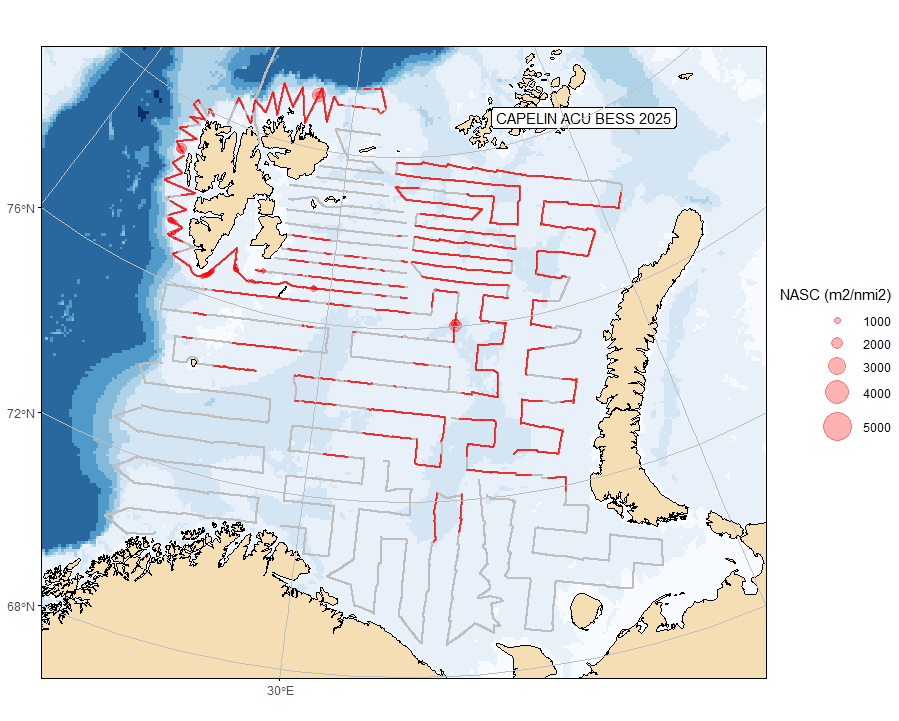
The assessment is based on the autumn acoustic survey in the Barents Sea and a forward projection to April 2026, including natural mortality and predation from immature cod. Key results include:
- Maturing capelin biomass (fish 14 cm and above that will spawn in 2026) is estimated at about 124000 tonnes on 1 October 2025.
- Predation by immature cod from January to March 2026 is estimated at about 74000 tonnes.
- Only a zero catch option gives at least 95 percent probability that the spawning stock biomass will exceed the 200000 tonne escapement target in April 2026.
Any commercial harvest would increase the risk that the stock falls below the critical level and would not meet the agreed precautionary rules.
From scientific advice to management decisions
The IMR PINRO report forms part of the formal scientific basis for management. The process is:
- IMR and PINRO carry out joint surveys and stock assessment work.
- JRN AFWG compiles the assessment and prepares advice on fishing opportunities.
- The Joint Norwegian Russian Fisheries Commission decides whether a fishery will open and how any quota will be shared.
Based on the current advice, expectations remain that there will be no Barents Sea capelin season in 2026.
Market implications and Global Fish view
The likely absence of a capelin fishery, combined with reduced quotas for North Sea herring, points toward continued tight roe availability in 2026. NVG herring roe will be produced, but volumes will not compensate for the lack of capelin roe.