The Road to the 2026 Atlantic Mackerel Season
Publisert den 02.07.2026 av Per Arne Fagervoll Meek
From summer ecosystem surveys to the first catches, preparations are already shaping the season ahead.
For the Norwegian pelagic industry, the Atlantic mackerel season represents far more than the start of another fishery. It marks the beginning of a period that will influence production, trade and market developments for months to come. While much of the pelagic fleet is still completing the North Sea herring season, another important phase has already begun. Scientists are now carrying out the annual mackerel and ecosystem survey in the Norwegian Sea, marking the first major milestone on the road towards next year's stock assessment and quota discussions.
Across Norway's coastline, preparations are quietly gathering pace. Fishing vessels, processors, exporters and customers are all entering one of the busiest and most important planning periods of the year. While the first commercial catches still lie ahead, the Atlantic mackerel season has, in many ways, already begun.
More than just another fishing season
Every Atlantic mackerel season tells a new story.
Weather, migration patterns, biological development and market conditions all contribute to shaping the months ahead. Yet despite annual variations, Norwegian Atlantic mackerel has built its international reputation on one characteristic above all else: consistent quality.
Atlantic mackerel has earned its reputation over decades. From Japan and South Korea to Southeast Asia, the Middle East and increasingly Europe, consumers appreciate its rich flavour, naturally high Omega-3 content and remarkable versatility. Whether prepared for sashimi, grilled whole, canned or used in value-added products, few wild-caught fish combine premium eating quality with affordability as successfully as Atlantic mackerel.
During the summer feeding season, mackerel migrate through the cold, nutrient-rich waters of the North Atlantic, building natural fat reserves that give the fish its distinctive flavour, firm texture and exceptional nutritional profile. This natural cycle is the foundation for a product that continues to be highly valued across international seafood markets.
The season begins before the first mackerel is landed
Although the Atlantic mackerel season is approaching, much of the Norwegian pelagic fleet remains active. The North Sea herring fishery is still ongoing, with some vessels having already completed their allocations while others continue fishing. For many vessels, the transition from herring to mackerel will take place gradually throughout August, and in some cases the fisheries may even overlap.
This seasonal progression is a familiar feature of the Norwegian pelagic industry and requires careful planning across the entire value chain. Fishing operations, processing capacity, logistics and customer programmes are continuously adjusted as the fleet shifts from one fishery to the next.
Unlike many fisheries around the world, the Norwegian pelagic fleet does not switch from one species to another overnight. Individual vessels follow different fishing strategies depending on quota utilisation, fishing opportunities and operational planning. This creates a gradual build-up of mackerel landings rather than a single starting point for the season.
From research to management
One of the most common misconceptions in seafood markets is that quota decisions alone determine market developments.
In reality, the process begins months earlier with science.
This week, the Institute of Marine Research launched the annual mackerel and ecosystem survey in the Norwegian Sea. Over the coming weeks, research vessels will cover approximately 2.5 million square kilometres across the Northeast Atlantic, collecting biological and environmental data that forms one of the key scientific inputs to the annual stock assessment.
The survey is part of a wider international scientific collaboration involving several coastal states. Once the data has been analysed alongside information from commercial fisheries and previous surveys, it contributes to the scientific advice that ICES is expected to publish on 30 September. That advice subsequently forms the biological basis for international quota negotiations and future fisheries management.
The timeline below illustrates how scientific work, management decisions and market expectations develop throughout the year.
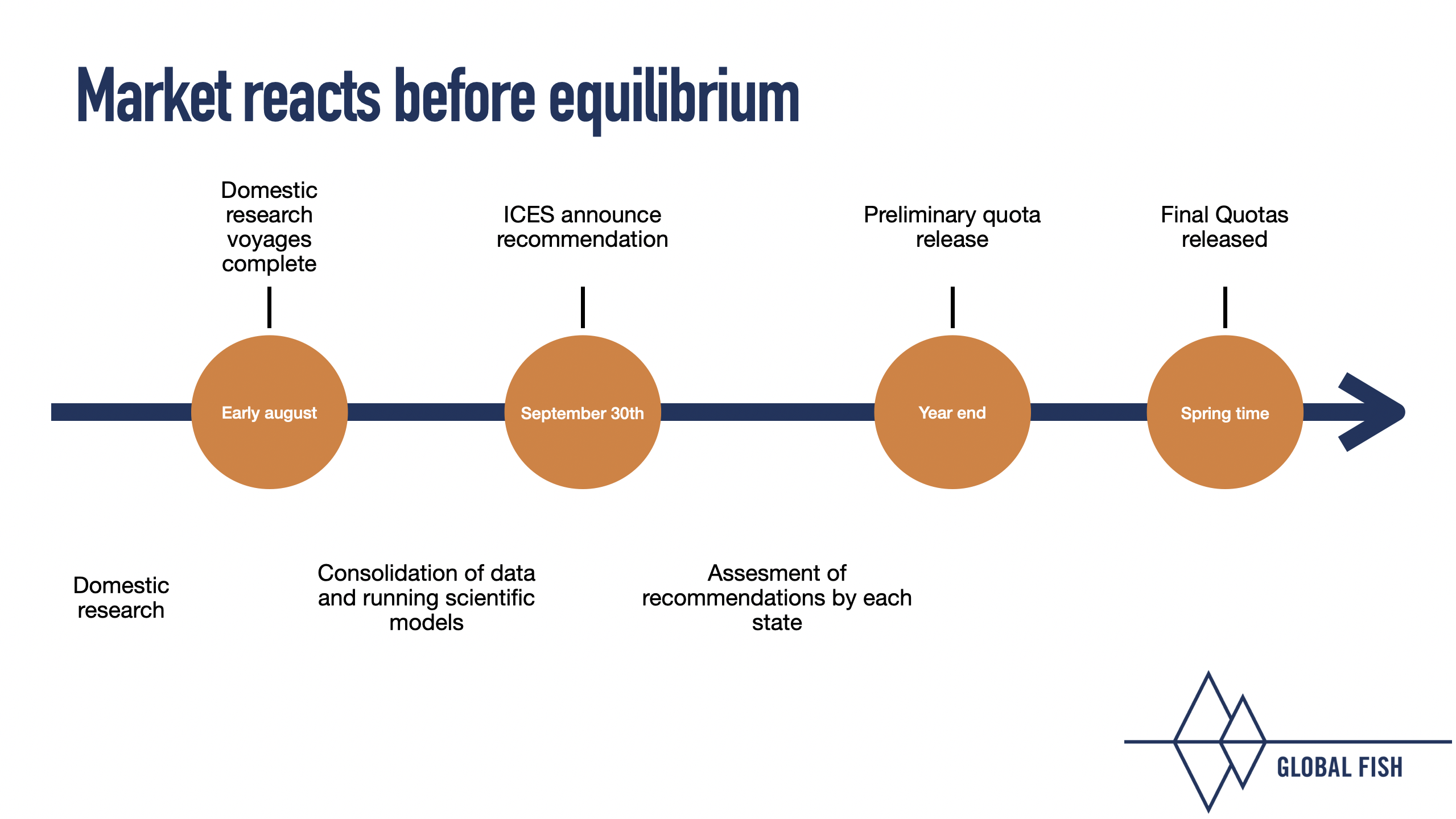
Figure 1. The annual timeline from ecosystem surveys to ICES advice, international quota negotiations and implementation of national regulations.
Markets often react before decisions are made
One important lesson from previous years is that markets rarely wait for final quota decisions.
Importers, processors, retailers and exporters continuously evaluate scientific developments, fishery performance, exchange rates and customer demand as new information becomes available. Expectations therefore begin influencing purchasing behaviour well before official quota levels are agreed.
This makes the coming months particularly important?not because every question will be answered immediately, but because each milestone gradually improves the industry's understanding of the season ahead.
Scientific discussions continue
The outlook for future Atlantic mackerel management remains one of the most closely followed topics within the pelagic industry.
This year's discussions surrounding future catch opportunities highlight both the strengths and the challenges of modern fisheries science. As new survey information becomes available and different assessment models are evaluated, the range of potential management outcomes remains unusually broad. This reinforces the importance of allowing the full scientific process to run its course before conclusions are drawn.
Depending on how the scientific data develops over the coming months, discussions currently range from considerably more restrictive catch opportunities to significantly higher quota levels than those currently being fished. The ongoing research is intended to reduce this uncertainty before ICES publishes its formal advice at the end of September.
A resource for today and for the future
Atlantic mackerel remains one of the North Atlantic's most valuable wild pelagic resources. Annual surveys, international scientific cooperation and responsible fisheries management all play an essential role in ensuring that this resource continues to support coastal communities, food security and global seafood markets for generations to come.
Although annual catch opportunities may fluctuate, the industry's long-term commitment to sustainable management and responsible harvesting remains unchanged.
Planning through uncertainty
Every fishing season brings new variables. Fish migrate differently, weather conditions change, biological assessments evolve and markets respond quickly to new information.
While these factors cannot be controlled, they can be understood.
With decades of experience supplying Atlantic mackerel to customers across Asia, Europe and emerging markets, Global Fish closely follows developments throughout the season to help customers navigate changing market conditions. Our ambition is not only to deliver premium seafood, but also to provide timely market insight that supports better planning and informed purchasing decisions.
Looking ahead with confidence
While important scientific and management decisions still lie ahead, preparations for the coming season continue across the Norwegian pelagic industry.
At Global Fish, this period is about more than production planning. It is about maintaining close dialogue with customers, sharing relevant market insight and ensuring that every part of the supply chain is prepared for another successful Atlantic mackerel season.
Atlantic mackerel has earned its position as one of the world's leading wild-caught seafood products through exceptional quality, responsible management and strong international demand. Those fundamentals remain firmly in place.
As the season approaches, we encourage customers to begin discussions early regarding product specifications, packaging requirements and delivery programmes. Early planning continues to provide the greatest flexibility as market activity increases in the months ahead.
The first catches may still lie ahead, but the Atlantic mackerel season has already begun; in the preparations, the science, the planning and the partnerships that will shape the months ahead.