Understanding the Forces Shaping Tomorrow's Fisheries
Publisert den 07.07.2026 av Per Arne Fagervoll Meek
Most discussions in the seafood industry revolve around quotas, landings and prices. Yet these are only the visible outcomes of a much larger process taking place beneath the surface.
Long before vessels leave port, marine scientists have already spent months surveying the Norwegian Sea and the Barents Sea. Their work provides an early indication of the environmental conditions that influence how fish stocks develop over time.
Two independent scientific assessments published this year reach many of the same conclusions. Rather than focusing on individual species alone, they highlight how ocean conditions, plankton, recruitment and ecosystem interactions together shape the fisheries that processors, exporters and seafood buyers depend on.
Looking beneath the surface
This year, the Institute of Marine Research's Resource Overview 2026 and the Joint Russian-Norwegian Arctic Fisheries Working Group Report 2026 offer valuable insight into the broader developments taking place across the Norwegian Sea and the Barents Sea.
Although prepared independently and for different purposes, both reports describe many of the same underlying themes: changing ocean conditions, shifts in plankton communities, weaker recruitment in several stocks and the importance of understanding marine ecosystems as interconnected systems rather than individual fish stocks.
Rather than pointing to a single cause, the reports describe how several environmental drivers are changing simultaneously. This reinforces the importance of understanding the ecosystem as a whole.
The foundation begins with the ocean
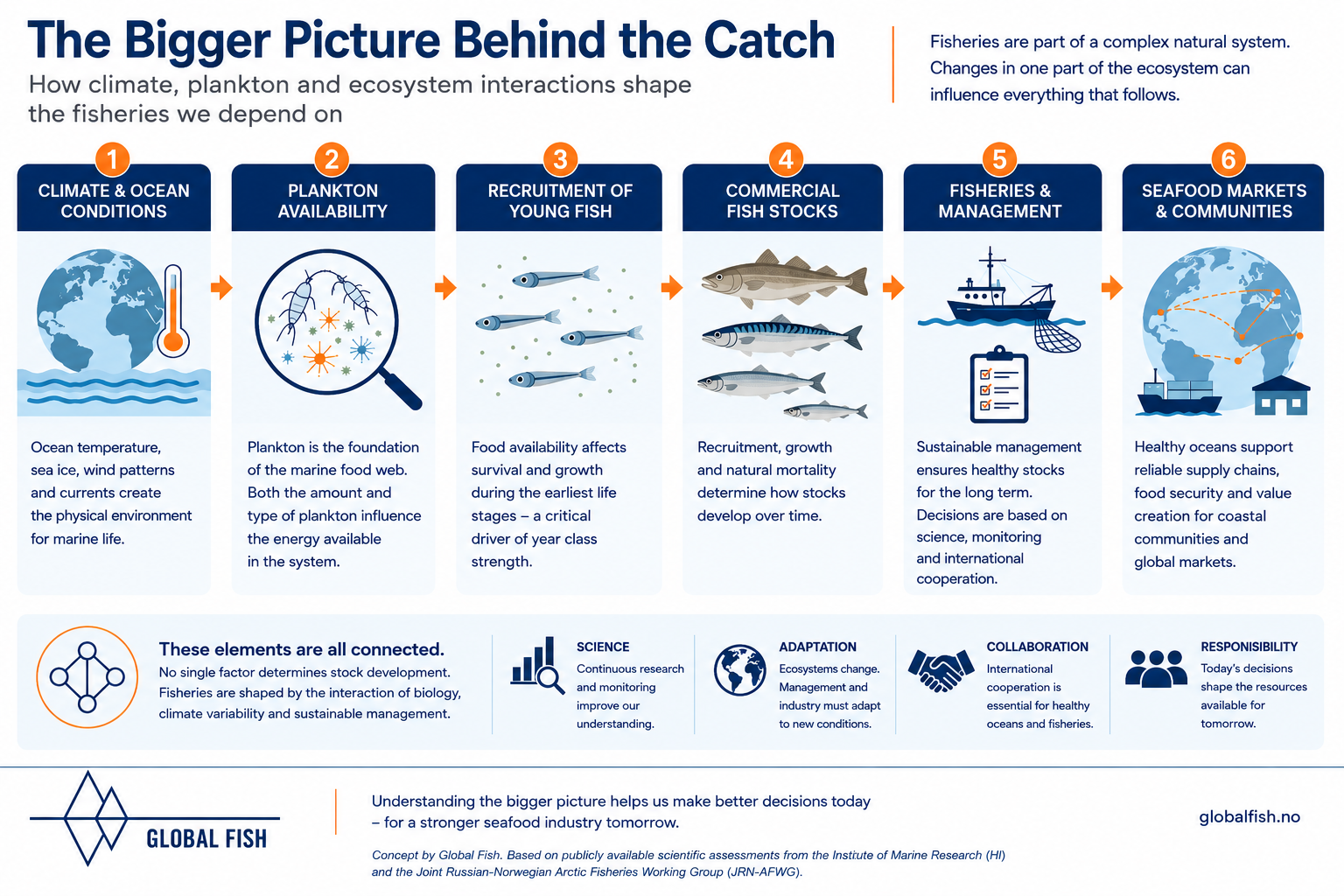
Both reports describe northern waters that remain warmer than historical averages, with reduced sea ice and changing ocean conditions across large parts of the Barents Sea and Norwegian Sea.
Scientists are careful not to draw overly simple conclusions. Climate is only one of many factors influencing marine ecosystems. Ocean circulation, natural variability and food availability all interact to determine how fish stocks develop over time.
Changing ocean conditions influence everything from plankton production to the distribution, growth and survival of commercially important fish species.
Small organisms, big consequences
Although largely invisible to most people, zooplankton forms the foundation of the northern marine food web.
Both reports highlight changes in plankton communities during recent years, including shifts in abundance and species composition. These small organisms provide the energy that supports young fish during their earliest life stages, making plankton one of the key building blocks of future fish stocks.
It is a reminder that changes at the very bottom of the food web can gradually influence the entire seafood value chain.
Recruitment shapes tomorrow's fisheries
If there is one scientific term that appears consistently throughout both reports, it is recruitment.
Recruitment describes the number of young fish that survive long enough to join the adult population. Strong year classes can support fisheries for many years, while weaker recruitment gradually influences the productive capacity of a stock.
Several commercially important species have experienced weaker recruitment during recent years. At the same time, the picture is far from uniform. Norwegian Spring Spawning herring is supported by strong 2021 and 2022 year classes, while other stocks show different patterns. The reports illustrate that every species responds differently to changing environmental conditions.
Capelin illustrates the connections
Few species demonstrate the interconnected nature of the Barents Sea better than capelin.
As one of the region's most important forage fish, capelin links plankton production with predators such as cod, marine mammals and seabirds. Following several stronger year classes earlier in the decade, the latest assessments indicate weaker recent recruitment and lower biomass during 2025.
At the same time, juvenile Norwegian Spring Spawning herring continues to occupy important nursery areas within the Barents Sea. Together, these observations illustrate how closely connected the ecosystem has become.
Capelin is therefore more than a commercial species. It is one of the clearest indicators of how energy moves through the northern marine ecosystem.
What does this mean for the seafood industry?
These reports should not be interpreted as forecasts of next season's catches, nor as signals that northern fisheries are becoming less reliable.
Instead, they provide valuable context for understanding why stock assessments evolve over time and why sustainable fisheries depend on much more than annual catch limits.
Norwegian fisheries remain among the world's best managed. Long-term scientific monitoring, ecosystem-based research and international cooperation provide the knowledge required to adapt management as conditions change.
For seafood buyers, processors and exporters, understanding these broader developments offers valuable perspective beyond landings, prices and quotas alone.
Looking ahead
The ecosystem surveys currently taking place in the Norwegian Sea will add another important piece to this picture before new scientific advice is published later this year.
While annual quotas will always attract the greatest attention, the broader scientific assessments remind us that sustainable fisheries begin long before catch limits are discussed.
Understanding the forces that shape our oceans ultimately helps producers, processors and seafood buyers make better-informed decisions today and for the future.
Sources: Institute of Marine Research: Resource Overview 2026; Joint Russian-Norwegian Arctic Fisheries Working Group: JRN-AFWG Report 2026.