Global Fish Update
24 October 2026
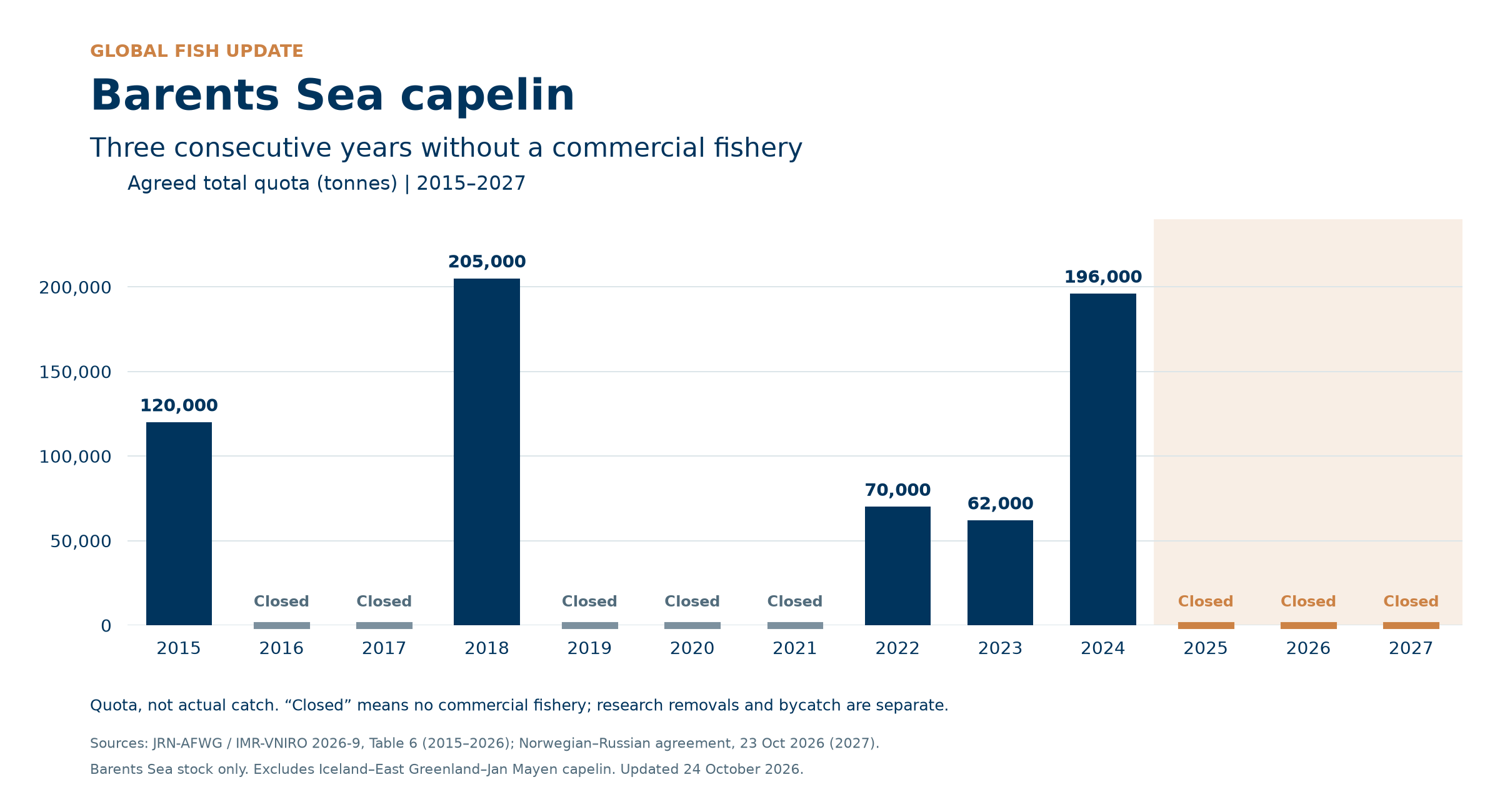
Norway and Russia have agreed not to open a commercial Barents Sea capelin fishery in 2027. The decision follows the scientific advice published earlier this month and extends the closure to a third consecutive year.
The agreement was signed on 23 October. For customers planning capelin and roe programmes, the position for this stock is now settled: there will be no new commercial catch from the Barents Sea in 2027.
From advice to a third year of closure
In our December 2025 article on the scientific advice, we outlined the weak outlook for the 2026 season. We subsequently reported the decision not to open that fishery. The latest agreement continues that sequence: no commercial opening in 2025, 2026 or 2027.
The new advice was issued on 19 October by the Joint Russian-Norwegian Working Group on Arctic Fisheries (JRN-AFWG), bringing together scientists from Norway's Institute of Marine Research and Russia's VNIRO. It is bilateral scientific advice, rather than an ICES catch recommendation.
A depleted stock and weak recruitment
The autumn assessment estimated total capelin biomass at 234,000 tonnes, of which around 60,000 tonnes was maturing fish. The projected median spawning biomass for April 2027 is only 18,000 tonnes, even without fishing. These are different measures: the autumn stock includes fish that will not spawn next spring, while the projection also accounts for losses before spawning, including predation by cod.
According to the Institute of Marine Research, the maturing stock is the second-lowest recorded since systematic measurements began in 1972; only 1987 was lower. Both immature fish and the youngest year class were well below their long-term averages.
The institute describes a new period of stock collapse and cautions that recovery may take time. Capelin has recovered quickly in the past when recruitment conditions improved, but the latest findings provide no firm basis for setting a reopening date.
The current rule remains in place
The agreed rule requires at least a 95% probability that 200,000 tonnes will be left to spawn. Norway and Russia have retained that rule for the 2027 decision.
The commission will continue examining possible changes to the harvest rule. That work has not resulted in a new rule or an opening for 2027. Research and management removals are addressed separately from the commercial closure.
What this means for supply planning
For buyers of whole capelin and capelin roe, the practical consequence is another year without new raw material from a commercial Barents Sea season. Supply programmes will need to be based on verified inventories and availability from other fisheries.
This decision concerns Barents Sea capelin only. The Iceland-East Greenland-Jan Mayen stock is managed separately, and its quota and seasonal outlook must be assessed on their own basis. A closed Barents Sea fishery should not be read as a closure of all capelin fisheries.
We will follow further stock assessments and management decisions for both stocks. Please contact your usual Global Fish representative to discuss origin, product specifications and delivery requirements for your capelin and roe programmes.