Global Fish Update
23 October 2026
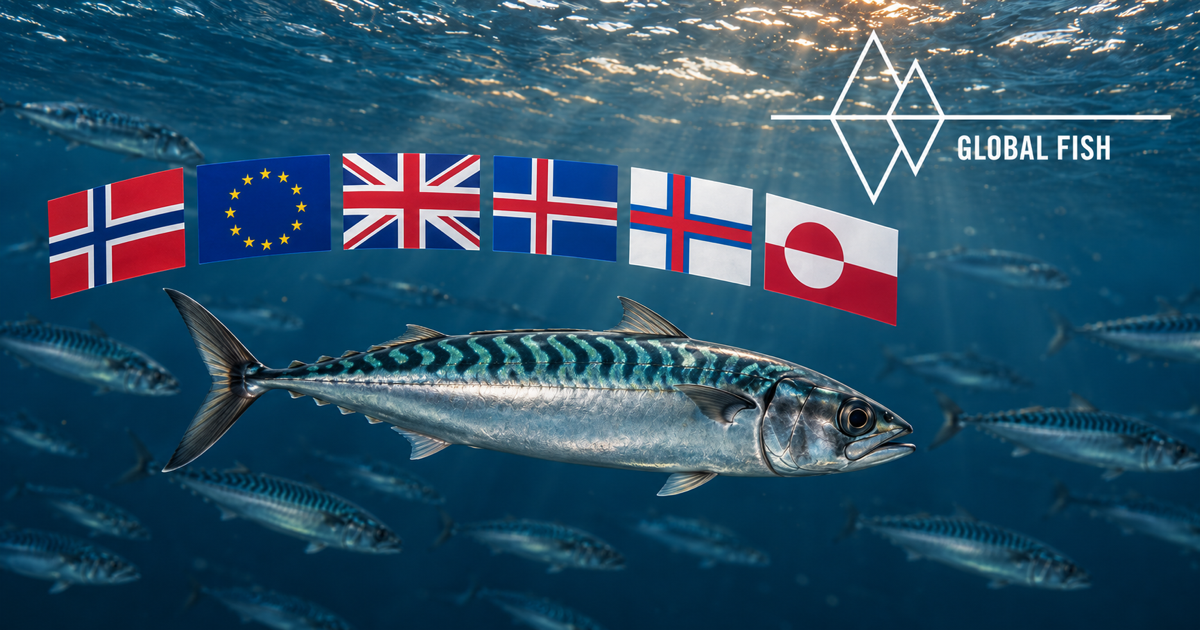
The six coastal states have agreed a Northeast Atlantic mackerel TAC of 352,938 tonnes for 2027, matching the ICES recommendation. The agreement brings clarity on the intended catch level earlier than we anticipated. National shares remain unresolved.
Norway, the European Union, the United Kingdom, Iceland, the Faroe Islands and Greenland reached agreement following consultations in London on 20-22 October.
This moves the process beyond the scientific advice covered in our September update. The same catch level now has the support of all six coastal states. The next task is to agree how it should be divided.
An earlier milestone in the quota process
In our update following the summer survey, we illustrated the sequence from fieldwork and stock assessment to scientific advice, coastal-state negotiations and national quota decisions.
ICES published its advice on 30 September, and the coastal states agreed the catch level just over three weeks later. That is earlier clarity on the overall framework than we anticipated when outlining the process this summer. It does not mean that the full quota negotiations have been completed.
The signed record states that the parties will reconvene as soon as possible to address quota sharing. It gives no date for completing those discussions.
From advice to national quotas
- 30 September 2026: ICES advice published.
- 22 October 2026: Six coastal states agree a TAC of 352,938 tonnes.
- Next: Quota sharing negotiations; national allocations and access arrangements remain to be resolved.
EU and Greenland join the agreement on TAC
For 2026, Norway, the UK, Iceland and the Faroe Islands based their four-party arrangement on a reference TAC of 299,010 tonnes. This was not a six-party agreement on the catch level.
The inclusion of the EU and Greenland in the new agreement is therefore significant. All six now support the same TAC for 2027. Agreement on the size of the TAC does not, however, settle each party's share.
Our September article illustrated what a TAC of 352,938 tonnes would mean if the four-party arrangement's published net percentages were retained. Those calculations were scenarios, not adopted national quotas.
They remain conditional. A broader sharing agreement could change the percentages used in that illustration. The October record neither establishes replacement shares nor states that the existing four-party arrangement has been superseded.
For Norway and the other parties, the final outcome will depend on the allocation negotiations and subsequent arrangements for transfers, flexibility and access.
Higher than the 2026 reference TAC, below expected catches
| Reference | Tonnes |
|---|---|
| Four-party reference TAC for 2026 | 299,010 |
| ICES forecast of total catches in 2026 | 398,186 |
| Agreed TAC for 2027 | 352,938 |
The agreed TAC is 18.0% higher than the four-party reference TAC for 2026, but 11.4% below the 2026 catch forecast used by ICES. That forecast is not a final catch figure.
The increase of approximately 54,000 tonnes should therefore not be presented as an equivalent increase in total fish available to the market.
Actual catches in 2027 will also depend on how the agreement is implemented. Russia is not a signatory, and the record does not establish a Russian allocation for next year. The agreement alone therefore does not ensure that total catches will remain within 352,938 tonnes.
Recovery still requires careful management
Agreement at the level recommended by ICES is a positive development for management of the stock. It does not change the underlying scientific assessment.
As discussed in our September article, the improved outlook remains subject to uncertainty. The Norwegian government also stresses that the stock situation is still serious.
The parties refer to their work on a long-term management strategy in the signed record. No new strategy or timetable for its completion is adopted in this agreement.
What this means for supply planning
For buyers and processors, one major uncertainty has narrowed: the six coastal states now agree on the intended catch level.
National allocations and access arrangements remain essential to understanding where and when the fishery will take place. Catch timing, fish size and product yields will then determine availability across commercial grades.
Global Fish will follow the allocation negotiations and update the supply outlook as national fishing opportunities become clearer. For now, the agreement is an important step towards the 2027 season, with the distribution of those opportunities still to be settled.
Sources
Norwegian government announcement, 22 October 2026.
Signed coastal-state record, 22 October 2026 (catch level, allocation negotiations and management).
HI summary of the ICES advice for 2027 (advice and 2026 catch forecast).
Four-party mackerel arrangement for 2026 (reference TAC and allocation framework).