Atlantic Mackerel Survey Completed
Publisert den 29.07.2026 av Per Arne Fagervoll Meek
The Norwegian survey has been completed. International scientific assessment now begins ahead of ICES advice and future quota decisions.
2026 ATLANTIC MACKEREL SERIES
PART 3
The Norwegian leg of the annual Atlantic mackerel ecosystem survey has now been completed, marking the end of the fieldwork phase.
The international scientific assessment that underpins future fisheries management is now beginning.
Over the coming weeks, data collected across the Norwegian Sea will be validated, combined with observations from the other participating countries and incorporated into the international stock assessment process for Northeast Atlantic mackerel.
For the seafood industry, this marks the transition from research at sea to scientific assessment, management advice and, ultimately, quota negotiations.
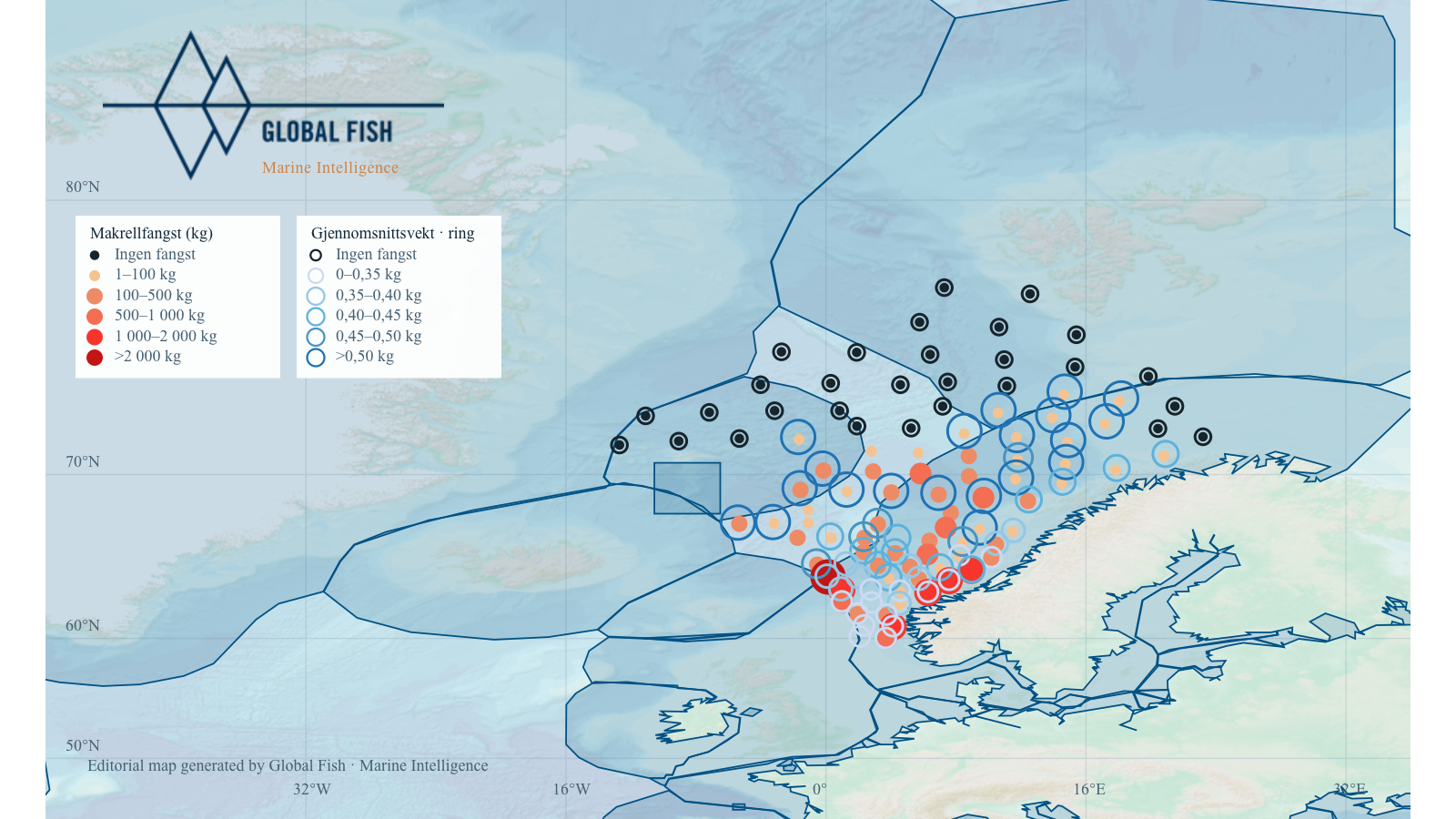
Editorial visualisation by Global Fish Marine Intelligence. Source data: Norwegian Institute of Marine Research (HI).
Figure 1. Editorial visualisation of the preliminary distribution of survey catches and average fish size based on published observations from the Norwegian Institute of Marine Research (HI). The illustration highlights geographical patterns but should not be interpreted as a stock assessment.
Improved survey coverage
According to the Norwegian Institute of Marine Research, this year's Norwegian survey benefited from three additional survey days funded by Norges Sildesalgslag.
The additional survey time improved coverage in important mackerel distribution areas, strengthening the scientific dataset and helping to reduce uncertainty across key parts of the survey area.
The Institute of Marine Research also reports that the largest catches during the survey were recorded in the central and eastern Norwegian Sea, while larger individual mackerel were generally observed further north.
These are preliminary field observations and should not be interpreted as conclusions regarding overall stock size or future fishing opportunities. The full assessment will only be available after observations from all participating countries have been reviewed and incorporated into the international scientific process.
An international scientific effort
The annual Northeast Atlantic mackerel ecosystem survey is conducted jointly by research institutes from Norway, the Faroe Islands, Iceland and Denmark.
Using harmonised survey methods, each vessel covers a designated part of the Norwegian Sea before the observations are combined and quality-assured during the international post-cruise workshop.
The resulting dataset forms one of the key scientific inputs to the ICES stock assessment, which in turn underpins the scientific advice used in subsequent fisheries management decisions.
Participating research vessels in 2026:
Vendla and Eros - Norway
Jákup Sverri - Faroe Islands
Þórunn Þórðardóttir - Iceland
Dana - Denmark
The Next Phase Begins
Although the fieldwork has now been completed, several important stages remain before management decisions can be made.
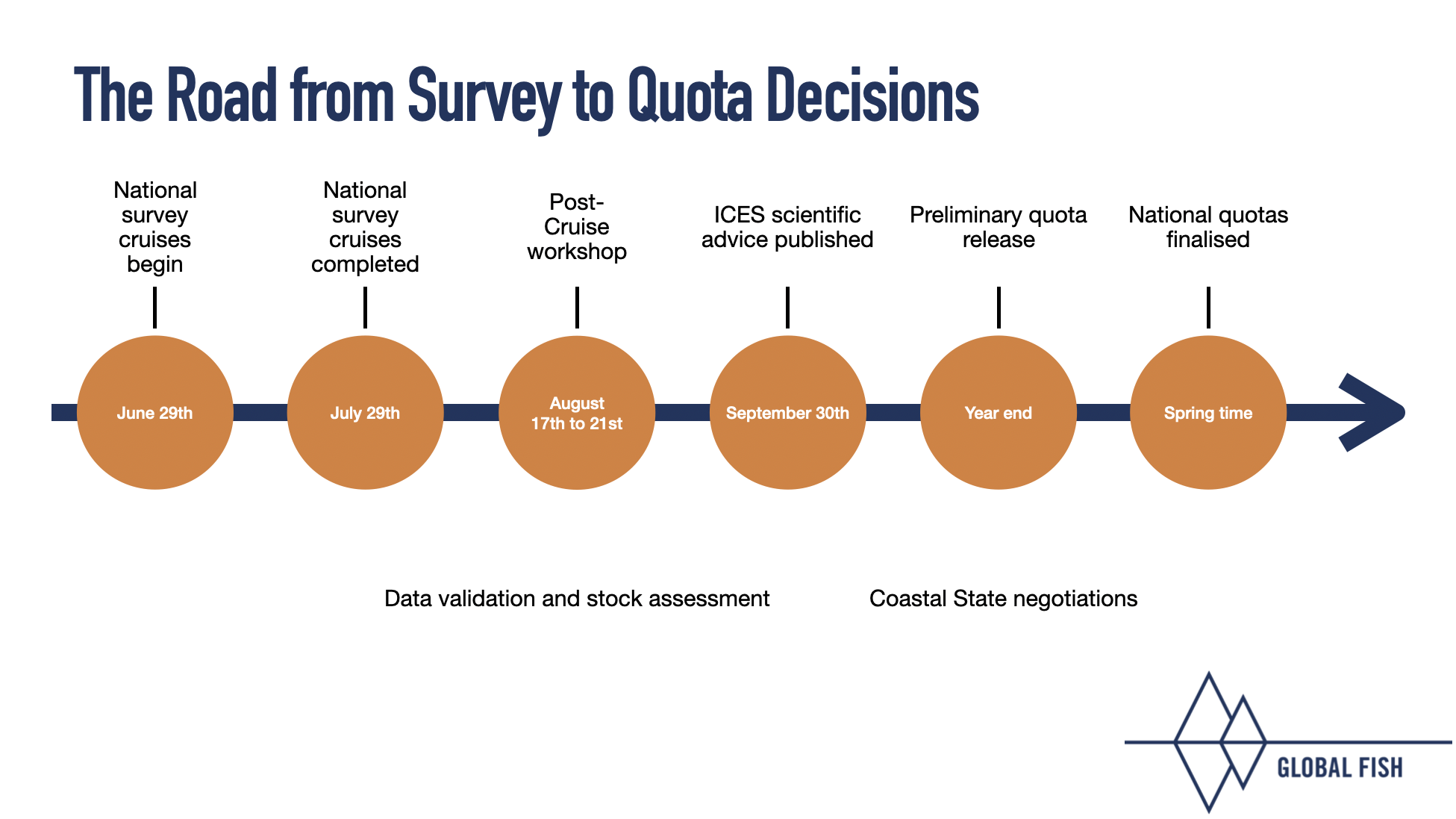
During the international post-cruise workshop in Copenhagen from 17 to 21 August, scientists from the participating countries will review, validate and harmonise the survey results.
The results will then be incorporated into the assessment models used by the International Council for the Exploration of the Sea, contributing to the scientific advice for Northeast Atlantic mackerel scheduled for publication on 30 September.
That advice provides the scientific foundation for the subsequent Coastal State negotiations, where future management of the stock and national fishing opportunities are discussed before quotas and regulations are finalised for the 2027 fishing season.
Why it matters
For seafood buyers, processors and exporters, the ecosystem survey represents far more than a research cruise.
Reliable stock assessments help build confidence in future supply expectations and remain one of the foundations of sustainable fisheries management.
Although markets often react long before quotas are agreed, those expectations ultimately depend on robust scientific data, international collaboration and transparent stock assessments.
The completion of the survey therefore marks the end of the fieldwork phase, while the scientific assessment and management process is only beginning.
Looking ahead
With the survey work at sea now completed, attention shifts to the international scientific collaboration that will shape this year's stock assessment.
Over the coming months, the industry will move through several key milestones - from the post-cruise workshop and publication of the ICES advice to the Coastal State negotiations and eventual quota decisions for 2027.
Global Fish will continue following each stage of the process, providing regular updates as scientific knowledge is translated into fisheries management and, ultimately, future market conditions.
In parallel this autumn season will progress and current indications suggests that the Norwegian fleet might be on fishing field come mid August.
2026 ATLANTIC MACKEREL SERIES
Part 1 - Preparing for the 2026 Atlantic mackerel season
Part 2 - Halfway through the ecosystem survey
Part 3 - Atlantic mackerel survey completed