2026 Norwegian Mackerel Main season Begins
Publisert den 25.08.2026 av Per Arne Fagervoll Meek
2026 Atlantic Mackerel Series - Part 4
| Opening indicators | ||
| 165 tRadek Average weight: 520 g |
250 tHargo Average weight: 504-545 g |
160 nmNorthwest of Ålesund Reported fishing area |
| Initial observations only. The first catches should not be interpreted as representative of the full season. | ||
The Norwegian mackerel season is under way.
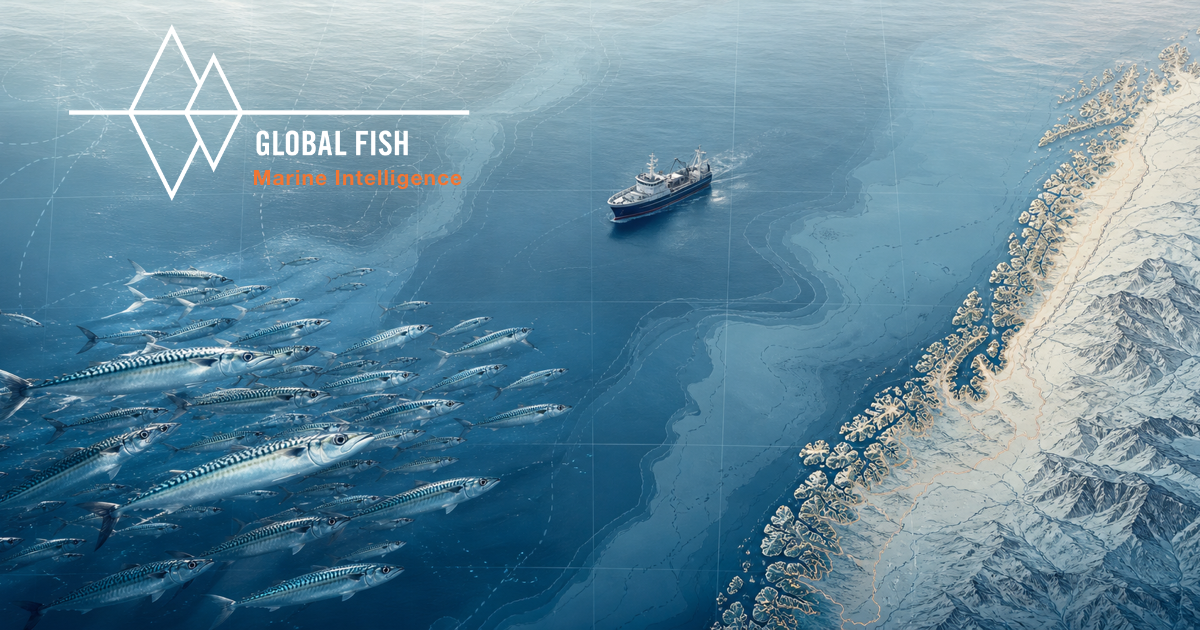
Radek reported 165 tonnes with an average weight of 520 grams on 23 August. Later the same evening, Hargo reported a total of 250 tonnes, with average weights ranging from 504 to 545 grams. According to Norges Sildesalgslag, the catches were taken on established mackerel grounds approximately 160 nautical miles northwest of Ålesund.
The previous article noted indications that the Norwegian fleet could reach the fishing grounds around mid-August. The opening ultimately came later, with Norwegian vessels moving towards the grounds during the weekend of 22-23 August.
This followed a summer in which Russian and Greenlandic vessels had been present in international waters for an extended period. Icelandic vessels joined later and were still active close to the Norwegian-zone boundary as the Norwegian fleet began its season. Vessel positions and tracks show activity and movement, but do not by themselves document catch volumes or catch rates.
Large fish and a positive first quality indication
The initial catches indicate a high proportion of large mackerel. The reported size distributions nevertheless show why average weight alone does not provide a complete picture.
Radek reported 27% above 600 grams, 55% between 400 and 600 grams, 17% between 250 and 400 grams and 1% below 250 grams. Hargo reported no fish below 250 grams and a lower share in the 250-400 gram interval.
Both vessels reported feed grade 3. Initial feedback from the receiving side indicates good quality and that the type of feed present had not damaged the raw material. This is more informative than the feed grade alone, but it is still based on the first landings and should not be generalised to the wider season.
Norges Sildesalgslag emphasises that August can be a demanding period. Successful purse-seine fishing depends on the mackerel aggregating and remaining sufficiently high in the water, while both the availability and type of feed can affect catchability and quality.
A season shaped by both biology and market conditions
The 2026 season begins with lower supply expectations and a market that has already adjusted to historically high price levels. At the same time, buyers in several important markets are showing greater caution, and higher costs have contributed to lower import volumes.
At Global Fish, we are pleased to have already received interest from several buyers as the Norwegian season gets under way, and we expect more buyers to enter the market over the next few days. This early engagement confirms that demand is present, even as customers assess the new-season quality, available sizes and overall price level.
This creates a more complex opening than size alone suggests. Large fish may be commercially attractive, but the final market outcome will also depend on quality, total available volume, the pace of landings and how much of the higher cost can be absorbed further along the value chain.
What happens next
More Norwegian vessels are now heading towards the Norwegian Sea. The next landings should provide a better basis for assessing:
- whether the large size profile is consistent across the fleet;
- actual fat content, texture and feed condition;
- catch rates and the ability of the fleet to build commercial trip volumes;
- market response in Asia and Eastern Europe; and
- how quickly fishing activity shifts between the Norwegian and UK zones.
The first vessels appear to have found fish relatively quickly. Conditions in the Norwegian Sea can nevertheless change from one day to the next. A handful of positive catches is therefore not yet a representative picture of the season.
The first catches provide a clear signal of large fish on the opening grounds. They do not yet tell us whether the same size profile will persist across the fleet, how the fish will perform in production or how quickly the distribution will change as the season develops.
That is the next stage of the 2026 Marine Intelligence picture: moving from survey-based distribution in July to verified catch, quality and production data from the main season.
Global Fish will continue following the season as new landing, quality and market information becomes available.
2026 Atlantic Mackerel Series
Part 1 - Preparing for the 2026 Atlantic mackerel season
Part 2 - Halfway through the ecosystem survey
Part 3 - Atlantic Mackerel Survey Completed
Part 4 - Norwegian Mackerel Main Season Begins
Some illustrations made with AI